Showing posts with label ducks. Show all posts

Tuesday, May 15, 2018

Day Four … S is for Shutter Priority

The S mode (Shutter Priority, TX on Canon cameras). Its very simple to use you set the shutter speed and ISO and the camera chooses the best aperture for you.

There is a lot of advice out on the net and in how to books about the importance of keeping shutter speeds fast enough to avoid camera shake. So setting the shutter speed sounds like a good option. It is also helpful if you need to you can “freeze” action by using and ultra fast shutter speed (like 1/2000th of a second), faster infact than a blink of an eye. While I did use this mode on older film cameras, I have seldom used this setting on any of my digital cameras (I’ll explain later below in this post). Like most cameras  my new Olympus OMD E M10iii does have an S mode and I was trying to think where I might use it and I settled on birds in flight (be warned that is a challenging subject to try yourself especially starting out, kids on a bike would be a better choice)

That was a bit easier said than done, It was a cold dull overcast morning that Melbourne gets a bad reputation for but aren’t really all that common. So there where not many birds out and about. I figured ducks would still be out, supposed this is the weather they like, so it was down to the lake.

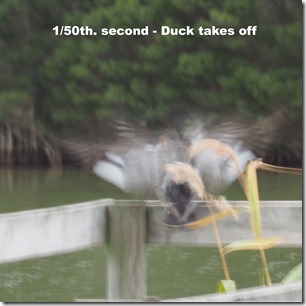
Slow speed - stationary duckSlow speed moving duck -> blur
Fast speed flying duck -> sharpFast speed landing duck -> sharp

Despite starting to drizzle the duck did perform for me. He was sitting on the wooden rail on a small pier as I approached and a photo with the shutter speed set to a 50th of a second was almost ok (the image has a slight blur but the duck is recognizable despite the low light and slow speed). However as he took off, the next photo, also at 1/50th second is just a blur of feathers. He circled around which gave me time to change the shutter speed and catch him flying in and about to land at 1/2000th. of a second. Now most of the duck is in sharp focus (perhaps expect for him trimming his wing tip feathers). So Shutter Priority mainly helps in deciding weather you want blur or sharpness when you subject is moving. I probably won’t be using this mode to often, but it will help is some situation (if I have enough time to change the mode dial and the shutter speed before my subject has disappeared into the distance. Which it generally has.)  Thus you need to plan when using this mode before the action starts.

Tuesday, April 05, 2016

Tale of two cameras

I am often asked which is the best camera, and I usually answer “the one you already have”. Some times I might change it to “the camera you like to use”. Basically all modern digital cameras from camera phones up, well more specifically those with about 4 megapixels and higher (ie less than 4 years old) are great. Will a new camera make a difference? Yes maybe, but it probably has a lot more to do with the person behind the camera.

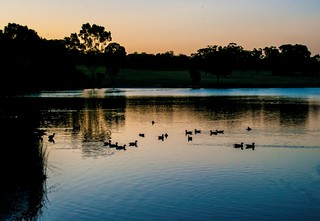
 2016-04-04_18-20-40_HDR #95_IGP3351-Ducks_at_dusk

The photo above left was taken on my android phone using a camera app called HDR Camera+, which processes the HDR image in the phone, and then it was loaded via the flickr app as soon as I got  good wifi. All pretty automatic. The image on the right came from my big DLSR, it is part of a bracketed set (that didn’t work so well because the ducks where moving, and I abandonned using HDR). I had to load the RAW file into lightroom and do some tonal adjustments and a slight trim then into OnOne for some dynamic contrast adjustments and a big softy vignette (all my favourite “style” adjustments). I have presets that do these steps, however I didn’t use them it didn’t take long but it took time but I prefer to adjusted things manually. It also had to manually uploaded to flickr (flickr’s nice Uploadr is no longer available to me because I have a Free account).


The two photos are different, and I would put down the difference mainly to the quality of the lens (on my DLSR) and a little bit to my post processing skill. However I see these two photos as markers of where photography is heading. The smaller cameras where a lot more of the smarts about how to process the image are built into the camera, or phone. In other words a smart camera with software doing a lot of the work. Compare this with the modern DLSR it is big and clunky, they can mostly can take amazing detail photos, but the controls are largely in the hands of the photographer and his/her vision is usually also required to get the most out of post processing. While I love it in the second more traditional place (the right hand side above) I can see the future being towards smarter and probably smaller cameras (the left hand side above) and I think you can expect to see more many improvements to come there. DLSR are not dinosaurs about to become extinct, a lot of folk including me still love them but they have definitely plateaued in term of technical development, but they can capture wonderful images.

Wednesday, July 23, 2014

One Duck Done Six Ways

_IGP4192_picasa _IGP4192_gplus
Picasa :: jpeg
I’m feeling lucky
Google+ :: jpeg
AutoEnhance & Vignette/Blur
_IGP4192_aftershot _IGP4192_pse
AfterShot Pro :: RAW
Perfectly Clear & Vignette
Photoshop Elements :: RAW
Spotlight Effect
_IGP4192_lightroom _IGP4192_perfectenhance
Lightroom :: RAW
Tonal Adjustments, Noise Reduction & Vignette
Perfect Photo Suite 8 :: RAW
Perfect Enhance, Magic Erase Brush & Vignette
A couple of ducks wandered into the front yard late this afternoon it was overcast and getting foggy so I had to use a high ISO just to get an acceptable exposure with my telephoto lens. While keeping a high f-stop to avoid over narrow depth of field. The resulting images has a lot of digital noise and was just a little flat, but with potential, Giving me the perfect opportunity to see what my many software mistresses might be able to do to lift this shot. I’m not trying to compare the packages for equivalent features, more trying to play to their strengths.

Thursday, September 20, 2012

Spiraling into Divine Composition

croping overlay  in lightroom 4I need to begin this discussion by making a strongly held point, that most people intrinsically know good composition and will probably do better than say “the rule of thirds” or similar composition “rules”, just using their eye. However I must admit I have been having a bit of fun trying figure out why the Fibonacci Spiral (its called the Golden Spiral in Lightroom) might be a composition aid? The ratio behind the fibonacci series is roughly 1.618, so it doesn’t neatly cut a shape into one third two thirds but it is close. so I have heard this gold number referred to as the rule of thirds on steroids.  More importantly it has been known to artists as the Divine Proportion since the renaissance, and often used unwittingly by artists and architect before that.


I have found two ways to use the spiral as a guide. Firstly using the inner focus of the spiral to target the main point of interest (the ducks head in this example). So you need to toggle the orientation of the spiral overlay (using <shift> O repeatedly in Lightroom. Alternatively I have found the outer arc of the spiral a good place to line up strong contrast changes, letting them follow the sweeping curve (not shown here). While this second approach doesn’t draw your eye to a specific focus point but it does guide your eye around the image, in a pleasing way. The android app ProCapture has an onscreen Fibonacci spiral to aid composition, which is also fun on the phone because you see it as you are taking the photo..
vistor to my garden-cropped in lightroom

Sunday, June 03, 2012

PhotoProject :: Reflections


Just experiments editing video (using Live Essentials Moviemaker) of the reflections of waves, as some ducks circle around. Taken on a walk along the Scotchman's Creek Track, in the eastern suburbs of Melbourne. Taken with my Canon EOS 1100D (Rebel T3).

Friday, March 16, 2007

Mum...?


Mum...?, originally uploaded by imageo.

Not sure why I overlooked posting this photo when I took it. Its one of those warn fuzzy feeling photos. The big yellow duck is actually a public sculpture on show for the monash gallery of art. What I liked is the juxapositon with the real ducks, which don't seem very overwhelmed by their over sized cousin.

The panorama gives you a better view of the gallery and lake, a great setting for public art.


waverly art gallery panorama

Sunday, January 07, 2007

Wet weather specialist


Pacific`black duck [Anas superciliosa]

After a week of plus 30C days Melbourne at last has a cool change and a "little" rain, perfect weather for ducks