|
Register now through mga Booking Essential.

I can't make promises about the weather, but if its overcast and drizzly the birds will still be flying, so come and bring a raincoat and/or umbrella.
|
I can't make promises about the weather, but if its overcast and drizzly the birds will still be flying, so come and bring a raincoat and/or umbrella.
I have been running free PhotoWalks in Jells Park (and occasionally other locations) for a couple of years, and one of the biggest issues has definitely been the weather. I seem abnormally talented at picking either rainy/stormy or super hot/glary days, of course trying to pick the daily weather months ahead is my excuse.  I’m not sure I will ever be able to improve on this particularly given Melbourne’s notoriety for changeable weather. Still learning to exploit the conditions or at least not be limited by them is a great photographic skill itself.
Jell’s Park has an amazing array of birdlife, and my next PhotoWalk is in part timed to get some good bird photography opportunities. Last year around this time there were hundreds of Ibis arriving at night, a family of regularly Spoonbill cruising the lake at dusk, Herons, large flocks of Wood Ducks grazing on the lawns, So I planned a late weekday walk (to avoid crowds) in the golden hour light before dusk. Should all be pretty reliable, given favourable weather right? Well not quiet looking around now the Ibis have pretty much abandoned the lake (and left their favourite island a wasteland), so have the Spoonbills and only a few grazing Ducks are still around.

However all is not lost. Yesterday I went on a late afternoon scouting trip looking for the best locations and likely bird species to capture. Rather than Ibis and Heron I saw Egrets and Pelicans. Rather than numerous ducks on the ground their were sulphur Crested Cockatoos and Galahs (not shown) and a lots of small birds flitting in and out of the light (also not shown) and plenty of cormorants, moorhens, coots and ducks.

So the next Photowalk should be really worthwhile if you want to try your hand out at photographing birds or just enjoying the afternoon light.
If you’d like to join us please Register via Eventbrite.
I haven’t really had the opportunity to test out my higher rate burst mode (continuous shooting) on the Olympus OMD EM10iii. Mainly I had not been in the desirable position of the sun behind me and a cross wind so any birds where taking off while they fly past as I panned. The magic happened late yesterday. Well the camera performed well.
I was shooting in RAW+jpeg and I got the above sequence in a little under two seconds. Not exactly 8fps as claimed but it does give a great range of the full graceful wing movement of a bird in flight. I’ve cropped in a little on the RAW versions, not perfect but I am impressed.
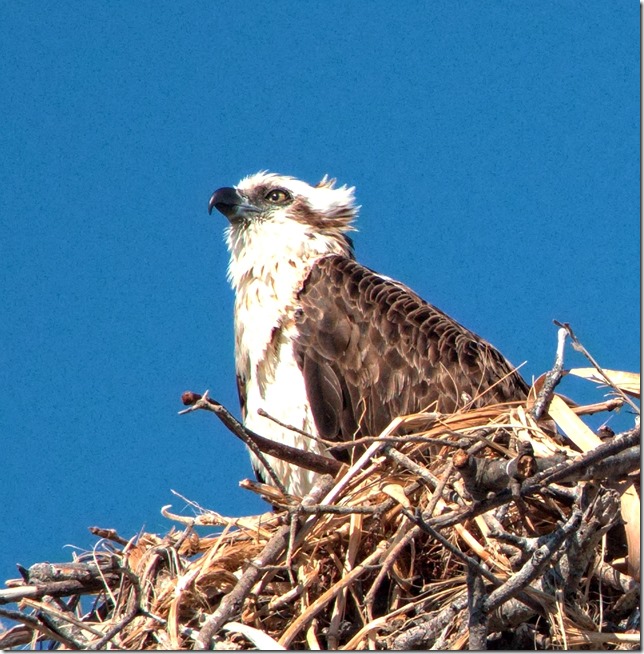
I felt it was time to do something creative for this blog (and instagram). I had selected this photo of the young Osprey on the nest on the Mooloolaba spit to make a painting or perhaps a pastel drawing. However I felt it also need to be reinterpreted as a “hand draw photo” using a combination of rendering approaches.
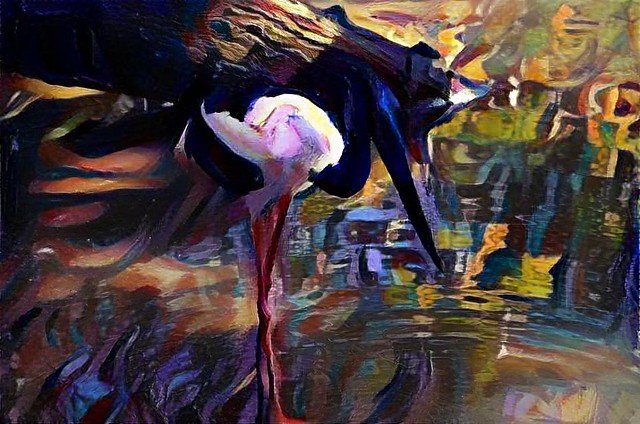
First I loaded the original photo into Google Deep Dream Generator and used the Abstract Nature trained AI filter. This created a darker rendering but I loved the strong blue colouring of the sky. Next I took this new version into Corel Painter as the work to base a clone painting using the artist impressionist clone brush and a linen surface texture and also emphasised warm colours or the plumage and nest.
For the Final Work (above) I used On1 Photo RAW and load the original photo as the base layer and the Clone painting as the second layer. Then I used soft light blending mode and used a semi-opacity masking, a lot like a homemade luminosity mask to bring out some of the original photo (eg almost 100% masking over the eye and beak, but variable 75% or lower on selected parts of the nest and feathers). I also lifted the vibrancy of the blue and yellow/oranges a fraction to give me a strong complimentary colour feel. Finally I cropped in a little to add a bit more drama to the composition.
Today is apparently World Photography Day. If you have been following my @normhansonphoto instagram feed you will have notice a couple of photos of an Osprey nest high on a pillar of the Mooloolabar spit, taken at different times of the day and under different lighting.
The walk was pleasant, and the big Sunshine Coast Marathon was finishing so the road blocks where being removed. However when I arrived at the nest only the chicks where home. After a short wait I could here one parent squeals and suddenly they where on the nest. I missed then flying in (and out). Still I had my long lens (zoomed out to 300mm) on and switched to S (shutter speed mode) and high speed burst mode. At 200 ISO and 1/400th second f8 to f11 giving a good exposure, all good. The parent had returned without food so there was a bit of complaining and they where scanning the skies for their partner. I moved around to the eastern side to get the best morning light on the birds and got many shots, even though they are stationary on the nest their heads where turning constantly so the burst mode helped get the best head position. Still I had a lot of almost duplicate images and ended up deleting approx. 30%. Then as quickly as they came the parent dove from the next and disappeared. I wasn’t quick enough to capture them in flight. Still I was happy with my efforts.


![Musk Lorikeet [Glossopsitta concinna]](https://farm2.staticflickr.com/1540/25777366092_cf8941e361_z.jpg)

My ripest grapes are being stripped from the vine just as the crop seems to be maturing beautifully. Well the poachers have become very brazen. Time to get some netting! I’ve also had to bring in the ripest bunches already, so I can enjoy at least some.


![Long-Billed Corellas [Cacatua tenuirostris].](https://farm1.staticflickr.com/564/21784382285_e9ec1c8717_z.jpg)

The Eurasian coot [Fulica atra], is very much just Black and White, Ok it has a Red eye. This image of one swimming close in a very muddy Jell’s Park Lake (from heavy rains a couple of weeks back) looks very drab in the out of camera raw view, with just the very basic lightroom rendering undertaken as the image is loaded (and in fact most RAW images tend to look this way)
RAW file straight out of camera | RAW from Lightroom with tonal adjustments | Basic Tonal Adjustments |
 |  |  |
*Whilst these are RAW images they must be rendered as JPEG to be viewed on the web and been Exported from lightroom as sRGB
Only a little bit of adjustment was required to lift the detail, and remove the flatness but the colour of the muddy water just doesn’t appeal to me. So I figured it was a good time to experiment with a more artist palette slant on the colour and some colourful way to lift this image.
Picasa Saturation Boost | Paint.Net Inverse Colour then Hue Slider & Inverse Colour Again | Cross Processing in Perfect Effects |
 |  |  |