Showing posts with label exhibition. Show all posts

Sunday, March 22, 2026

Pleasant Surprise at the 9by5 Exhibition

Yesterday I headed along to the City of Greater Dandenong Council's 9by5 exhibition opening at the Drum Theatre and was genuinely impressed. The foyer was packed with both a large crowd, and also with 225 works on show spanning a huge range of styles and media, from a few beginners right through to very experienced artists. Each artist could enter up to two pieces, and having everything the same size (9" by 5") made for a really cohesive exhibition. The organisers did a wonderful job fitting it all in.

My work ended up down the back (as usual), but I was pleased to find a red sticker already on one of my watercolours!

It was great chatting with some of the other artists. Everyone was enthusiastic and grateful for the opportunity to show their work. A point that kept coming up in conversation was how wonderful it is for people to be able to see and buy affordable original art, and I couldn't agree more.

The exhibition runs until 1st. May If you're on the south-east side of Melbourne, it's well worth calling in. and if you can't make it in person, the most works are also available to buy online.

Wednesday, March 02, 2022

The Connections Exhibition is OPEN


22 artists (including me) are represented with 82 works. If you want to "Meet the Artists" you will have that opportunity on Saturday & Sunday 5/6th March; 1-4pm

Thursday, February 24, 2022

Wednesday Wanderers and the Flow State

The wanderers began by happen-chance. Three of us started our own small plein air painting/sketching group out in the real world. Soon after Victoria began it first lock down and after a couple of rocky test, we started meeting on zoom on Wednesday at 10:00am. It was a welcome get together and we started painting a shared photo supplied by one of the participants since it was the free zoom meeting we only had 40 minutes for the session before we got cut off. Not a lot of time to carry out a watercolour painting of a scene you had not seen before.

The Watercolours Society of Victoria had purchased the Pro version of zoom and kindly allowed us to use their service so we were no longer bound by the 40 minute limit but kept the rough timing and format.

There is a Chinese proverb attributed to Lao Tzu

“If you are depressed you are living in the past.
If you are anxious you are living in the future.
If you are at peace you are living in the present.”

It is this being in the present when you are painting, that probably explains lot of the popularity of the Wanderers

Mihaly Explains
Mihaly Explains [watercolour on Canvas by Norm Hanson]

I believe it has a lot to do with helping the participants slip into what the Psychologist Mihály Csíkszentmihályi identified and calls the Flow State. In which the duration of time is altered, hours pass in minutes, minutes can stretch out to seem like hours.

After interviewing many successful people for his study of the Psychology of Optimal Experience, he concluded that there were seven common experiences shared by these people. He calls these the Elements of Enjoyment

  1. Confronted by a task, with a chance of completing it.
  2. Be able to concentrate on the task
  3. Task has a clear goal
  4. Immediate Feedback
  5. Could participate with a deep but effortless involvement (remove from the constraints and frustration of every day life)
  6. Be enjoyable (allowing people to exercise control over the actions)
  7.  Concern for self disappears (yet paradoxically the feeling of self emerges stronger after the flow is over.

Mihaly liked to explain this in two dimensions, the challenge versus skills.

He believes you can most easily move into flow if you are aroused (but anxious) by the challenge and you take the opportunity to practise and improve your skills, or you are confident in your skill (but bored) until you get inspired by the challenge. Flow occurs when a task’s challenge is balanced with one’s skill.

A very important aspect of the Wanderers is the group dynamic. Mihaly studied and advised many sporting groups including the successful  Australian Women’s Hockey team, Australian Olympics cyclists and ice skaters. He lists these important characteristics for teams to Achieve Flow and thus improve their collective performance by achieving group flow.

  1. Group empathy (including helping others to achieve their desired performance)
  2. Activity has clear goal
  3. Opportunity to be both autonomous and at the same time cooperating in the group.
  4. Immediate feedback (both personally and shared with the team)
  5. Skill required matches the difficulty of the task. Some individuals can focus on different skills 

Whilst we were not always in focused together, and seldom on all aspects. Those participating were generally focussed in the present challenge testing their skills and often reaching the flow state.  Mihaly says it is this flow that allows the enjoyment of experiencing that you are good at something while you are doing it. It didn’t matter so much if you had or had not finished or looked the same as others.

 Norm Hanson
Febraury 2022

Monday, February 07, 2022

Connecting What and Who are the Wednesday Wanderers?

 What were you doing during the lockdowns? (well assuming they are over

Here is something I did and we are having an exhibition, If you are in Melbourne or allowed into Victoria please come and have a look.


Wednesday Wanderers was born out of the COVID-19 pandemic.  Unable to meet or paint en plein air during strict lockdowns, three committee members from the Watercolour Society of Victoria were feeling isolated and fed up with their own four walls.  It’s easy to forget that before COVID, many people had never used or even heard of Zoom.  We used it to connect a diverse community of watercolourists interested in escaping from the pandemic blues once a week.  We adopted a quirky speed painting format that challenged our skills and fit in with the technology requirements. 

Immediately it became apparent that there was a need for something like this, as membership quickly grew.  It has enabled artists who could never have come to a real-world paint-out to spend time some enjoyable time painting together in a safe environment.  Time poor artists, artists who live far from Melbourne, housebound artists, and those caring for family members. 

 We continue to meet fortnightly now that lockdowns are presumably a thing of the past.  We now have Wanderers in many parts of Victoria, as well as New South Wales, Western Australia, and the United States.  We have become a warm, welcoming community that continues to grow.

,,, Jane Elliston


Thursday, July 26, 2018

Time to Smile

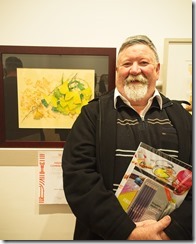
OLYMPUS DIGITAL CAMERA         I’m looking rather pleased with myself,  because I just got a highly commended for "my gingko leaves in time" pencil study at the victorian artists society student & teacher exhibition


The exhibition is on until 7th August.


Many thanks to VAS  & Art Spectrum

Sunday, June 10, 2018

Choosing Matte & Frame

Without realised it you can end up spending a lot of money framing a photo, especially if it is considered a “custom” framing. Frames that are made to measure can easily escalated  to well over the AUD$150 mark for the 16” by 20” size being considered.

There are three key decisions to make.

  1. Matte (Type & colour)
  2. Frame (Several Materials/Styles)
  3. Glass (or Plexi-glass Perspex)

Whilst these decisions can in practise be made independently, on the different components of the frame. It is usually best to combined and made at the time you order the frame.

imageA good matte makes a lot of difference to the look of a photo when framed. You also need to allow for a decent margin for the matte around the photo. The general advice for a 16” by 20” size would be a minimum of 3” on each side of the narrowest margins. Also it is common practice to make the bottom border slightly wider (see the embeded video at around 1:25:00 for an explanation) that the top margin. However there are no hard and fast rules for width and fashions change. The mattes should be cut from archive quality boards, which means either acid free. The mattes should also be cut to cover part of the photo being framed (a good reason to leave a small 1cm white margin around your image when getting it printed.

The glass or plexi-glass for the frame must be cut to match the internal dimension of the frame picture housing(the rabbet)  for frames up to the size we are considering and perhaps a little larger glass is the usual obvious choice. However larger frames can become very heavy and plexiglass is a better alternative here as it is considerably lighter

Finally A good way to save cost of framing is to buy premade frames. Unfortunately the quality varies so it is important to look and feel them rather than order of the internet. A lot but your local framing shop is likely to have a range of the basic sizes in the more popular styles (simple black style wood frame with glass is likely to cost between $40-$90 for the desired 16” by 20”. If you are preparing a larger exhibition it is worth asking for a discount and buy a “Job Lot” (10 to 12 frames). It worked for me.


Cutting mattes & making your own frames takes considerable practise, skill and the right equipment. It will be expensive and probably unsuccessful on the first few attempts (eg don’t get enthusiastic and buy lots of tools and expensive mouldings for that one print for an exhibition) but can be a rewarding additional hobby that will save you a lot on framing costs over time. The B&H video on matting and mounting (embedded above) is long and given by a product rep but is full of sound advice (Including the secrets to cutting a double mattes (1:29:25 in the video).

Thursday, June 07, 2018

Size Matters

Exhibiting your photos can be a really rewarding experience, and why not start locally such as at Local Camera Clubs, Local Councils and Schools (often as fund raisers) often run such exhibitions (usually with a reasonably small submission fee). If you haven’t created pictures for an exhibition before, here are few hints and guidelines to help your decision process.


1. Viewing distance
Galleries and conference centres often put a lot of work into this issue and it is in fact a complex issue depending mainly on a comfortable viewing distance, the viewer’s eyesight and the type of illumination. The crispness, sharpness of the images seldom even gets a look in key decisions. In most cases you will have no control over illumination but can assume it will be ok. The next issue is how the viewers is expected to see a lot of detail, a normal view or find the maximum distance before it is hard to appreciate the image. There are several complex theories and calculations, but there is also a decent rule of thumb that assumes the viewer has between 20/20 & 20/40 vision. It is called the “4:6:8” rule, and related the ratio of viewing distance to the height of the photo.
PhotoFunia-1528438916Galleries also know that the comfortable viewing distance adopted naturally by most viewers is 1.5 to 2m. They sometime move closer for a detailed look but this is the “normal” walk past position. Thus the vertical height 10” (25cm) to 14” (35cm) will give the best comfortable viewing distance to attract most of your viewers.  This is the size of the actual image not the matte & frame.
This viewing rule of thumb works well for your home as well, for example if you want a print to wow visitors across your 3m entry hall you should consider a print that is at least 38 cm (~15”) tall, which is 3000/8, to be appreciated. If you have put a lot of effort into the crispness to should consider 50cm (~20”) tall which is 3000/6. If they need to really see the detail they can walk across the hall and take a closer look. But you will have grabbed their attention by now and when your print is the right size they probably will want to take that closer look.
This is very much focused on the vertical distance, because most viewers will be standing not lying down. The horizontal width is also important and depends on the orientation (ie Portrait or Landscape). Thus 8” by 12” might be fine (A4 is close but a little smaller) for a portrait orientation but an 11” by 14” would be desirable for a landscape (A3 is a little larger but lends itself to allow more cropping options at the matting stage).
Assuming your are matting your photo (and well matted photos do look good, so why wouldn’t you) you need to allow for a decent margin for the matte around the photo, when selecting the final framing size. The general advice for a 16” by 20” size,  which is a very popular size for exhibition photos, should have a minimum of 3” on each side of the narrowest margins. (eg Portrait mode probably shouldn’t be wider than 12” horizontally & Landscape mode shouldn’t be wider than 14” horizontally). It is also common to have the matting with a photo slightly higher than midpoint vertically. This especially applies to longer thinner panoramas.


2. Aspect Ratio
The aspect ratio of most cameras (so called APC crop sensor and Full Frame sensors) follows the same aspect ratio as 35mm film which is 1 to 1.5 (often described as 2 to 3) BUT most common photographic print sizes are not in this ratio. The Micro Four Thirds camera have a sensor ratio of 3 to 4 and this is a little closer to common print aspects/print sizes.

P6050091          P6050113
However it is very likely that any image will need to be cropped (have some part trimmed off). It is best if you predetermine the size you want printed and get your software to trim the image to that ratio before you take it to get printed. Most instore photo kiosk where you load your photos will provide cropping guidelines but this is normally on a tiny screen.
The next post will options when getting your photo printed at a local store or service.

Saturday, June 20, 2015

The Importance of the Physical

I’ve just been to the 25th birthday party of the monash gallery of art and shared some of the yummy birthday cake. Best of all the place was buzzing and not just with friends of the gallery, lots of kids where enjoying the photobooth and other activities or just running around in the wonderful surrounding outside. Not a soul with their eyes glued to their phone or iPad.The current exhibitions brings together some highlights of the mga photographic collection, which in turns includes many key photos in the Australian photography. The photos are hung in salon style and their physical presence is very powerful, and yet they display much originality and clarity in the essence of the subject captured. This is a very welcome change when so much of what is promoted as art is gobbled up on social media and small screens. Yet it is dominantly just look at me, wanna-be celebrity, copy cat stuff. It is a pleasure to step back a pace or two and contemplate good photography hung large (well 10” by 8” up) on a wall.
Felicity by Patricia Piccinni

Wednesday, June 18, 2014

Sneek preview of “The Road”

one of Wes Stacey Photographs from his series the roadThis week’s photobook club was a preview of the hanging of the next exhibition at the Monash Gallery of Art. It brings our little group back to our first meeting where we where given the privilege of looking into Wes Stacey’s suitcase containing an extensive set of hand made photo books. He had collated photos from his travels in 1974 & 1975 into simple one page per photo diaries of his road trip around Australia.The photos are being hung in the same way the only other exhibition of these works (see below). However in the mga gallery the walls are still the deep dark tone used for the Bill Henson curated show, so the arrangement of photos look marvelous,  like a cross between very large contact print sheets or an analogue instagram photostream. The exhibition “The road: photographers on the move 1970-1985”,which also includes other important photographers works, about “the golden age of automotive travel in Australia”. wes stacey's original exhibition of the road series

Saturday, November 02, 2013

Hung and open …”meet the artist” next weekend

IMGP2084My exhibition “An Artistic Journey :: In Search of Sir John Monash” is hung and open at the Highway Gallery in Mount Waverley. It includes a range of my works, few of which I have been posted on the social webs, so if you are in Melbourne and interested in my geological panels, photography, and photo mosaic collages please consider coming along to the “meet the artist” on Sunday 10th. November.

My Monash works follow on from my previous geological panels and paintings, on the surface they are firmly represented by earthly things, the soil and rocks. Yet they also reflect on three key aspects of Sir John's life. His military life, his life setting up the SEC and powering Victoria and his passion to build the Shrine of Remembrance. They have been created with the assistance of an arts and culture grant from the Monash City Council, which allowed me to learn about casting and moulding, to bring stronger dimensionality into my geological panels, experiment with a range of materials and hold this exhibition.

IMGP2082

Saturday, June 25, 2011

The exhibition is over

After admitting on Radio, to Lindy Burns, that I take lots of pictures each day, saying “I take anything my camera is pointed at at the time” which “disturbed” even Tony Moclair. Well it isn’t really that bad you should be able to see, looking back through this blog, that I still find time to investigate interesting things and exhibit my work. Normal photographer type behaviour.

The Opening

Speaking of which. The Fractured Thread Exhibition is over. Despite all the photographers and friends at the opening (thanks for coming folks) there are only a few images mainly captured by accident, Enough to make a suitably fractured collage.

The Window's Live Photo Gallery Create ScreenI also wanted to finally get around to testing out the Windows Live Photo Gallery share tools. It was really fast and easy, just had to do the Authorization thing for flickr first, and I took the opportunity to change the image size from original to max 1600pixel wide. Not only does this save bandwidth, it makes it less likely that you will find your image used in an ad campaign, without your permission.

The real GEM in these Window’s Live share tools is the SkyDrive upload. It is not as good as having your sky drive as a network drive letter, but it is simple easy to use and fast. Much easier and faster than the previous default methods, using old fashioned web pages with logins and “empty”upload dialogue pop up screens. Now it is select the photo (or photos) follow by two key clicks, on the Create & then Publish/Skydrive icons. Ok there is still one pop dialogue screen but you usually just have to click on the Publish key. For me at least this means that SkyDrive is now worthwhile using the 25 Giga Bytes that sky drive offers, for cloud based backup (not archiving) and sharing

Tuesday, May 31, 2011

Fractured Threads Exhibition

an extension of the still photograph
RAMP GALLERY pano
Rob Birze & Sandy Birze and myself are having an exhibition of our Photography in The Ramp Gallery of The Monash Gallery of Art. We are three local photographers who came together through the VIC/TAS thread of the Australian Photographers Group in Flickr. We are all active on the photographic social webs, sharing interests in some common themes, multi exposure, multi-image works and fresh ways to look at still photography. Our techniques are very individual and authentically photographic. Using both film and digital photography they bring together multilayers of details and glimpses in time to create very strong impressions of the subjects they photograph.
Exhibition runs from May 31 to June 19
Gallery Opening Hours: Tues to Fri 10am–5pm
Sat & Sun 12noon-4pm