I had a great opportunity yesterday while walking on the wall of the Cardinia Reservoir to test out the reach of my new olympus OMD EM10iii camera, using just two lenses (14-150mm and 75 to 300mm) and a multi-image stitched panorama.
Showing posts with label telephoto. Show all posts
Showing posts with label telephoto. Show all posts
Monday, September 24, 2018


Sunday, June 12, 2016
PhotoProject :: Non-Bending Macro

Cracking and bruising some ribs a couple of weeks ago has slowed me down a lot. Especially in terms of getting out specifically to take photos.
This week I was planning to do some more on macro/closeups and just focusing on textures. Unfortunately that typically means a lot of bending, not something I want to do at the moment. However my favourite telephoto (a old sigma 70-300 DL Macro Super, no idea what the super stands for) has a macro setting, that basically lets you focus in close when using the longest focal lengths.


Focusing close in this case is however 0.5 to 2 meters, not inches, away. This is perfect because I can stand and just focus at around ground level, ie no bending required. So I was able to get out in the garden (between rain showers) and have some close up fun.


Friday, May 02, 2014
Viva La Difference


A lot of folk ask me why I shot with two different cameras. The simple reason is I mainly use the Canon if I am likely to also take a movie, or it is to document my consulting work but the Pentax remains my “goto” camera. So I’ve started to take a few comparisons with each in different situations. What I can see (and have known for a while) is the Canon colour is always warmer, which actually 
Enough to change my mind of which is my “goto” camera NOT YET!
Sunday, April 14, 2013

Sunday, November 06, 2011
Meet the Frogmouths


Mr. & Mrs (order unknown) and the two kids. The Tawny Frogmouth Podargus strigoides, these owls are very equal opportunity parents sharing egg incubation and brooding duties. These two chicks are delightful little bundles of fluffy feathers
Saturday, January 27, 2007
Is focal length still relevant?
Focal length is seldom mentioned anymore in the same breath as digital photography, the jargon has moved onto times zoom. Not that this is that clear, you have to understand the difference between optical zoom (the lens being able to change its focal length) and digital zoom (just a part of the image being magnified in the camera, without any improved resolution). Even with digital SLR cameras which have interchangeable lens, most people just buy a zoom lens, so they pay little attention to focal length.
Increasing the focal length of the lens you use (either by changing the lens on a DSLR, or zooming in) narrows the field of view and magnifies the subject (making it look closer). Higher focal length lenses are called telephotos. Decreasing the focal length expands the field of view and the image looks further away. Lower focal length lenses are called wide angle, because of their wider angle of view.
So here is a demonstration of the magnification and field of view obtained with different focal length. To fully appreciate the difference in magnification involve try if you can see the small "turret" on the house in the middle on the first image at the top, in the final image at the bottom. You will need to click on the images to see the larger versions.
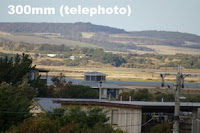

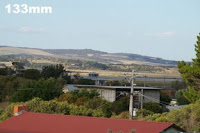

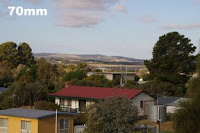


Whilst a 50mm lens best matches the perspective and magnification of the human eye on older 35mm film cameras, a focal length of 33mm approximates the normal human vision on a digital camera, which has a smaller CCD sensor area.
If you are interested you can find the focal length used for images in the EXIF data embedded in most Jpeg or RAW file formats these days
Changing the focal length also changes the perspective but that can be the topic of another post.
Increasing the focal length of the lens you use (either by changing the lens on a DSLR, or zooming in) narrows the field of view and magnifies the subject (making it look closer). Higher focal length lenses are called telephotos. Decreasing the focal length expands the field of view and the image looks further away. Lower focal length lenses are called wide angle, because of their wider angle of view.
So here is a demonstration of the magnification and field of view obtained with different focal length. To fully appreciate the difference in magnification involve try if you can see the small "turret" on the house in the middle on the first image at the top, in the final image at the bottom. You will need to click on the images to see the larger versions.


Whilst a 50mm lens best matches the perspective and magnification of the human eye on older 35mm film cameras, a focal length of 33mm approximates the normal human vision on a digital camera, which has a smaller CCD sensor area.
If you are interested you can find the focal length used for images in the EXIF data embedded in most Jpeg or RAW file formats these days
Changing the focal length also changes the perspective but that can be the topic of another post.
Friday, December 15, 2006
the fruit bowl

Just mucking around took this still life with a telephoto lens to compress the depth of field (and throw the background out of focus). It worked well by the way.
Subscribe to:
Posts (Atom)