Showing posts with label Lens. Show all posts

Tuesday, April 21, 2020

Keeping your gear clean

When you get out to exercise, I trust you are taking your camera, or at least your smartphone, to take the opportunity to also exercise your photographic muscles. There is then the issue should you also disinfect your gear when you get home, The answer especially now is yes,  cameras and phones are something that you think nothing of bringing up to your face, for some time and there a couple of other important issues.


  1. Do not share your phone or camera with anyone you meet.
  2. Just putting it back in your camera bag is not enough.
  3. Wash your hands (thoroughly) as soon as you get home (you are more likely to be a source of infectious than your camera).
  4. Avoid using liquids to clean or disinfect any gear. (alcohol wipes may be out but probably unnecessary)

So when you get home take all you gear out of the bag and wipe it down with a microfiber cloth (the type you get from the supermarket as fine, they don't have to be black with a camera manufacturer's name on them. Take the opportunity to clean any lenses you used. It is not necessary to clean your sensor unless you change lens on a windy dusty day,, and that's not recommended anyway. You should wash the microfiber in soapy water, rinse and dry thoroughly before re-using.

Derrick Story goes into a lot more detail in his podcast "How to Disinfect Your Gear." The link goes to his show notes as well the podcast, as he has a some important sources of information there.

Friday, March 06, 2020

The Risks of more Megapixel, pin sharp fast Lenses and Pixel-peeping

The Risk of more megapixel, pin sharp fast lenses and pixel peeping is producing boring photo, putting pressure on storage, taking longer to process and not forgetting more expensive gear to start.

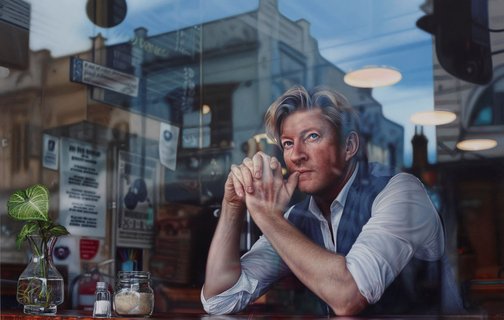
Photorealist painting from last years Archibal Prize

It is the same as for Photorealistic paintings, the work is technically outstanding but the Images soon become boring. Often very boring. Frequently the brilliant technical specs get overlook because their is nothing for the viewer to work out and keep their interest. In the art world there is a nice example in last year Archibald prize. The technically well executed and large Hyperrealist painting of David Wenham by Tessa MacKay was pretty much overlooked by the judges. Yet it was popular with the public and won the packing room prize, which is judged by the gallery staff who receive, unpack and hang the entries. In this case the artist has looked at a strong composition of building over the road seen through the glass window and painted reflections of the interior. So there is a fair bit to see but once you notice the detail becomes tedious and it back to being boring

Getting back to photographs, whilst other “purist” photobuffs, you tube watchers and owners of the latest and greatest cameras will enthusiatically discuss bokeh and edge to edge crispness. The average public viewer will look instead at the subject perhaps to composition and/or colour and perhaps interesting patterns or textures then they will move on. Capturing their gaze to look a little longer which usually depend on print size and viewing distance. Further weather you can interest them at that scale

Viewing distance and print size.

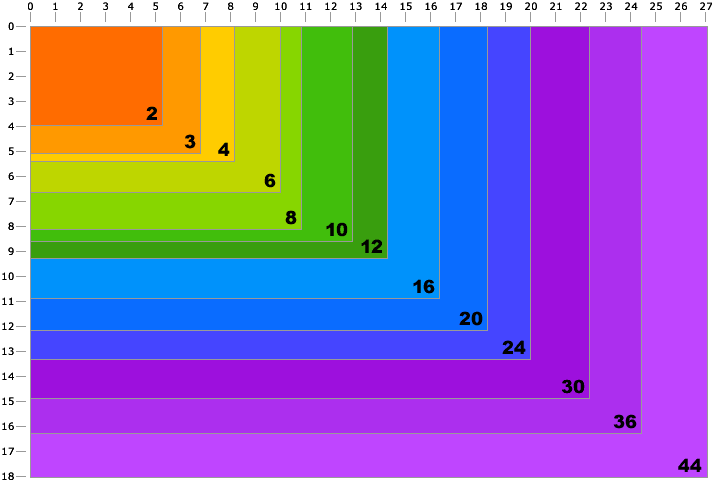
I have written about this previously, and that is a good summary. The issue here is you must concern yourself with the viewers eyesight media for display and type of illumination, print sharpness usually isn’t a real consideration.  There is also a lot written about this on the internet and a lot of it is only partially truthful and/or bias. The chart on the left show the relationship between common sizes (in Inches BTW) and the megapixel count of the image and assumes that you will want to print at 300 ppi (pixels per inch).  Each coloured rectangle then has the number of megapixels required for a given size. You will probably be surprised how few megapixels are required for common sizes. So what happens to all the extra detail capture on a full frame/high megapixel camera? Well they just get averaged together and that detail disappears

Capturing the Viewers attention

  1. On instagram/Facebook were images are displayed on small screens and this is potentially the place you can show your work to the potentially greatest number of people. Both Instagram and Facebook now use algorithmic methods to display your post, and they may very well limit the display to 20 cases and stop there if no one interacts with you post/picture. Thus if you are looking to become famous for your photographs you need to be already famous (ie have a lot of friends that follow and interact with you).  The images displayed  are tiny (and thus not detailed) and are normally held close. Unfortunately the viewer also has the ability to scroll through the images quickly. You might only have half to a couple of seconds to get them to stop and take a long look. This favours bold composition, strong colours and tones. #hashtags and clever titles.
  2. #72/365 My $10 PhotobookSmall prints. Portfolios and Photobook, larger Ipads and Tablets  have and arms length or less view distance and because they can be picked up and handled  they are likely to get the closest scrutiny. Thus they do need the required level of detail (eg 8 megatpixel for  10” by 8”). They should be designed the allow the viewer an extended period to inspect (this might include captions and perhaps a short paragraph of so to provide context.) They are likely to be the very best way to get anyone interested in your photography, having the massive advantage of social media sites on small screens in that they are something tangible and physical.
  3. On a wall (could be in a gallery or your home). This is the reason usually give for large sensors and High megapixel counts, it in theory allows for big prints (often gigantic) but this is probably the most challenging way to promote your work. Firstly large prints can be expensive to create and frame and it is likely to have the smallest number of viewers. Further the potential buyer is likely to consider these larger image as a décor items not art (ie does it make the couch)?

Tuesday, August 23, 2016

Don’t Stand So Close

The Lens BoxI have been having a little fun with a very cheap accessories I bought at Typo (yes the stationary and scrapbooking accessories place). Its a simple clip on design and the lens just sits over the small camera lens. It works fine on both my Android phone and my HP Spectre (a tablet laptop cross over) although there is some vignetting at the edges.


#234 Experiments with a cheap clip on macro\wide angle lens for my phone.

As a wide angle of a distant screen it is fine, but I’m not really a fan of the fish eye effect on a landscape. However letting it get right upclose (the macro aspect) definitely gives a different, aka interesting, perspective of some familiar items around my studio

Pentax & Tamrom Lens, my favourite comboCanon with zoom lens

The Red Wireless MouseThe Wandering Webcam

Saturday, June 08, 2013

Bigger and maybe brighter LCD screen for you camera.

I think most of us with LCD screens on the back of our DSLR or new digital compact camera know that looking at the LCD screen outside can be a real challenge, Firstly they are typically very small and more significantly they can be very hard to make out what is being displayed with the glare and reflections outside.

Somewhat by accident I discovered I already have a very cheap and easy to use, bigger LCD Screen on my camera. Ok not exactly on my camera but very easy to add. It was one of those (cheap) flat plastic magnifying lens. They are a type of Fresnel lens, a series of concentric lenses that appear as a single lens at around their focal length. I happened to have one inside a A6 sketch book in the back pocket of my camera bag, I frequently carry a small sketch book there. It isn’t exactly magic, you do need to tilt and twist and adjust the distance from the camera to get a decent view. However it is about twice the size of the screen and through a special property of the Fresnel lenses, which can capture more light at oblique angles (a feature that has made them very popular of lighthouses). There will still be glare and reflection on the lens but the image can be enriched and sharpened with appropriate tilts in the lens. The real draw back is it requires and extra hand, so works nicely with a tripod but your will have to juggle your camera in one hand and the lens in the other in most situation. Still it makes a big difference when you need to review your image in the field.

viewing the camera outside bringing the flat lens into position Viewing the camera back through lens

My A6 sheet lens only cosy $1.50 (from the $2 shop), but plenty of other (more expensive) forms and sizes are available from newsagents and officeworks.

Tuesday, March 05, 2013

What happened to the Aperture Ring?

My first SLR camera was a Pentax Spotmatic, which was a pretty revolutionary camera at the time, I got mine in 1969, because it had a built in lightmeter. You set the aperture with the lens ring and then you could rotate the shutter speed dial until the arm on the lightmeter visible on the right hand side of the through the lens viewfinder, was centered. If the speeds where too slow or two fast you could adjust the apeture ring. It was very easy to use and worked really well. I love it. A later camera body, also a Pentax,introduced me to aperture priority on a large mode dial. It allowed you to select an aperture and the camera itself choosing the shutter speed. More magic, particularly if you wanted control over depth of field.f stop overlayOver the past decade, or so, the separate appeture ring has disappeared off most lens. I suspect a lot of people haven’t even notice! Before we figure out what can be done without the aperture ring we should first look at -

What is Aperture?

Aperture is a measure of the size of the opening within the lens that controls the amount of light that reaches the film or sensor. It is usually given is a strange sounding unit f-stop
f-stop = focal length * diameter of opening
The strange sequence of numbers it is quoted in f/1.4 (f/2) f2,8 (f/4) f/5.6 (f8) f/11 (f/16) f/22 might make more sense when you realize that all are approximate multiples of √2(the square root of 2) and the amount of light reaching the sensor is proportional to the area of light on the sensor (ie πr²) Thus each f-stop is equivalent to doubling or halving the light. The bracketed numbers in the sequence above are the half stops.The lower F-stops let in more light and give you a faster shutter speed for your best exposure. Its as simple as that.
In most camera the size of the opening is controlled by a bit of clever mechanism, usually called the diaphragm, where a set of thin blades are pivoted, connected around the a ring shape and sprung in such a way that as the ring is rotated the blades expose a larger or smaller gap in the center.  This was the reason why the aperture control was on the lens (just at or behind the convergence point of the lens, Today most DSLR lenses have the same style of blade diaphragm but the control for setting the diaphragm opening is on the camera body, perhaps in a menu, perhaps as a separate wheel or disc. So you should find you are able to control the aperture setting even if your lens doesn’t have a ring to adjust it.
The Aperture setting is also one of the main factors in determining depth of field. the smaller the opening through which the light passes the greater the range of objects in your scene that will be crisply in focus on the sensor. This is why many camerphones with tiny lenses seem to have almost infinite focus. Whereas the larger openings (lower f-stop) will reduce the range of focus to a narrow band. Portrait photographers often use this to blur out distraction backgrounds but have the face just in focus

Monday, December 15, 2008

Lens Disaster

I’ll be the first to admit I am hard on my field gear, from boots, sunnies, phones, computers, I own and regularly use several devices with cracked LCD screens, and super glue or duct tape repairs. All this is a fact of life, I need things to be robust and reliable, that's all I ask.

The sad case of two plastic lugs Yet I must admit I was a bit devastated by yesterday’s “office” accident. My well padded camera bag (that by the way normally tolerates a lot of rough handling, apparently rolled off my desk and possible as it fell the camera must have spilled out and when I found it the camera and lens where well separated and bag open.Worst was to come, when I inserted the lens it just popped out again. Seems two small plastic lugs are all that holds it into the bayonet fitting, and the nature of the breaks does not give me any confidence that super-gluing will succeed. The saddest part is it is my favorite lens.