Showing posts with label night. Show all posts

Monday, May 18, 2015

PhotoProject :: Mapping the night sky

I have had a personal project for a while of trying to map the night sky, the southern half of the milky way. i have a great vanatge point at venus bay and when the night is clear and moonless I brave the cool and take a number if long exposure shoots. then my ambition is to stitch them altogether and create a map of the visiable sky (like our eye sees it rather tan through a telescope. It can be  pretty damn amazing. Night sky panorama.jpg

However I have found myself up against a numbers of technical issues. Trying to solve these will probably make interesting reading so I’ll post a little about my progress or lack of here, from time to time. The first issue is most panorama stitching software refuses to stitch stars on a black background. The exception is when I have a section of the horizon dimly lit as above which cover from due south to due east

Saturday, July 05, 2014

Under the Milky Way

milky way pano overhead milky way panio looking south

The Milky Way is high above us in the southern hemisphere at the moment and a moonless night without clouds gave me the opportunity to experiment with some autostitch panoramas of the milky way. 

Sunday, February 23, 2014

Slowing Down

I have been experimenting with night photography, I like to figure things out for my self. It was a moonless start to the night last night and largely clear skies (a few light clouds drifted by). The longest exposure I can get on my Pentax K20 (without manually holding the shutter down in B Bulb mode) is 30 second so I have had to open the aperture right up (only f4 on this lens) and really crank up the ISO to 3200 (I can go to 6400 but the digital noise is then too great). I did get some reasonable shoots but this one, take into the last two street lights in town does give the charming feel of man's artificial world trying to compete with the ancient light of the stars.

Moral : Despite the brilliant flash effect the manmade lights only create local pools of illumination. The Stars are eternal.

Monday, June 03, 2013

Waiting for the Aurora


Milky Way Panorama 1, originally uploaded by imageo.
The K-index has been 3 and over for the past few days which signals there is a possibility that the Aurora Australia will be visible from the southern coast of Victoria. Well it rained a lot but between breaks I got good views of the milky way arcing across the sky. Both these images are prepared from a sets of photos and stitched with Autostitch.

milky Way Panorama 2, originally uploaded by imageo.

Saturday, June 01, 2013

Starry, Starry Night


Some experiments with trying to map the sky at night. Using a set of 15 second exposures. Autostitch is actually up to the task, providing you have something detailed in the foregrounds, but I much prefer the warmer tines of my simple picasa picture pile collage.

Posted by Picasa

Thursday, July 14, 2011

Taking Photos at Night

2011-07-14

Taking photos when its dark is not something many people try without the flash,but there is a magic world of low level light out there. You just need a tripod and the means to take a long exposure.

Well I didn’t have either my tripod or my magic little remote control trigger. I did have my camera and It does have that useful B (B for bulb) settings. which holds the shutter open all the time the shutter is held down (much easier with the remote control. There was a flat balcony rail at my vantage point, and I could use it to hold my camera firmly to it. So with a little bit of experimentation. At ISO 800 I just started by hold the shutter open for 10 seconds, too dark, 20 seconds. still dark and finally 30 seconds, just right! Then I tried to capture a night time panorama (see collage above). That didn’t really work so well, but the two end photos worked out well enough.

IMGP8257 IMGP8255

PS: Most point & shoot digital cameras will have a night scene mode, it may not let you control the length of the exposure but it will give you an extended exposure without setting off the flash.

Thursday, August 20, 2009

Photographing the night sky

Taking decent photos of the night sky with a digital camera is Southern cross :: 34 second exposureslightly harder than finding night mode. There is a fair bit of good advice on the net but it is mainly aimed at the use of traditional film in 35mm SLR cameras. Fast film, open the aperture right up and long exposures, even special film. Not that there is anything wrong with that.
 Southern cross again :: 48 second exposure
The main checklist of important issue for the digital photographer are – 1) a tripod, to keep the camera steady during a long exposure, 2) a B (Bulb) setting (to allow extended time exposures) & Jupiter over Jupiter Boulavard3) a cable release or remote control to avoid camera shake.  Then maybe turn off auto focus and set the focus manually to extreme distance and maybe take off that UV or skylight filter. There are a few good extra hints and tips here.

Venus - Mars - Plaides aligment :: 52 second exposure

Wednesday, December 06, 2006

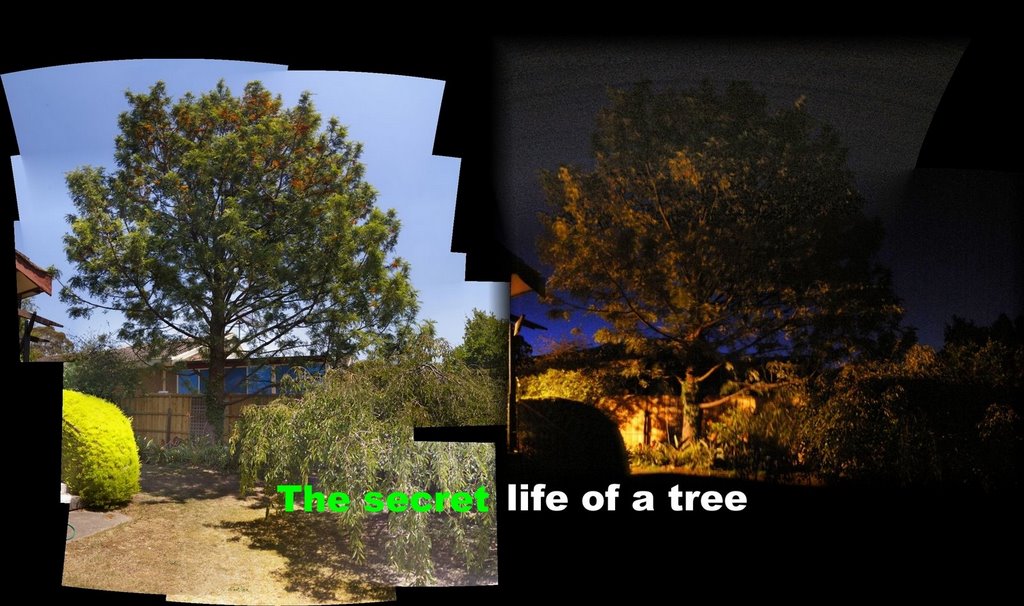
photomosaic, also in time

  Posted by Picasa
Grevillea Robusta - Southern Silky Oak, flowers with a distinct orangy yellow blossom just before christmas each year