Showing posts with label moon. Show all posts

Thursday, May 27, 2021

Yes I just had to photography the lunar eclipse


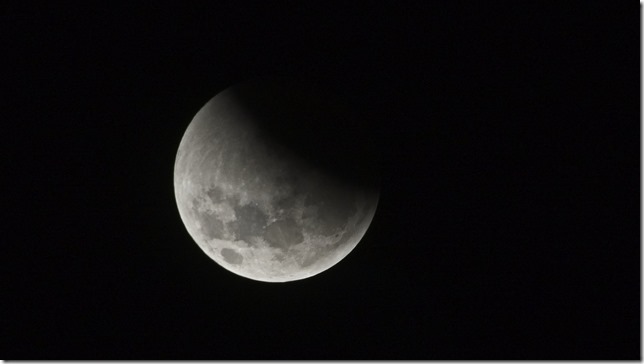
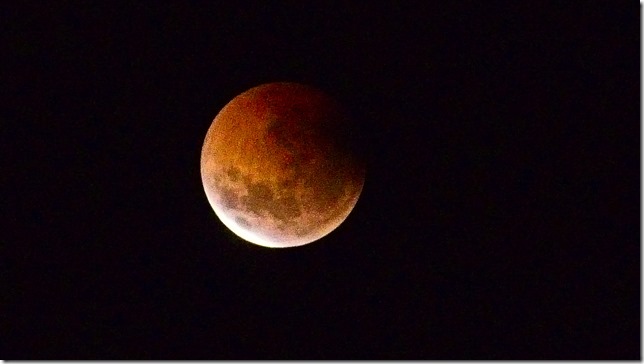
I have been able to photograph the lunar eclipse in 2014, 2015 & again in 2018, so I knew I must photograph last night's "blood moon" aka another Lunar eclipse. Whilst it didn't look so promising early, with thick cloud cover. As the eclipse progress it cleared to a magnificent, but cold, night. I actually found the best vantage point was right in my backyard. So I had my smallest camera and longest lens (giving the best reach) set up on a tripod with a timer on the shutter.


The colour wasn't as red as perviously, it was more a coppery red but still pretty amazing.

Wednesday, April 08, 2020

Challenges of Photographing the Moon

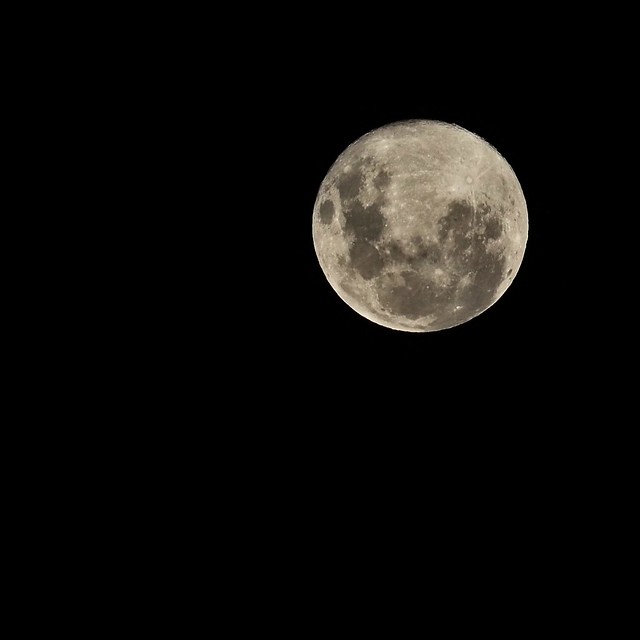
100/366 The Full moon from OZ
I must initially apologize in advance I'm sure you will see this image posted a lot tonight. This was taken around 7:30pm in Melbourne, Australia. I missed the moon as it rose above the horizon (because I can't see the eastern horizon from my place). I believe it had a golden tint . That colour coming from the earth's atmosphere, that the moonlight must travel through as it rises above the horizon.

I thought I should share my experience photographing the moon with a standard camera (I've used my baby Mirco Four Thirds model the Olympus OMD 10iii, if you want to see my exif data click on the image above and it will take you back to Flickr).

The first problem is the moon is well lit compared with a dark sky and the camera's selection of the best exposure (to achieve an average grey) is heavily biased by the black sky and tends to leave a very blown out moon with no detail. If you think about it the moon is being lit by the sun and is roughly the distance away from the sun as the earth so the illumination is the same as daylight here. A good exposure to get detail on the moon is very close to what we would use on a sunny day on earth (if you want to talk in M for manual terms, start around ISO 200 f8 and 1/100 second) Start around there and experiment a bit. I actually started there but using Apeture Priority and dropped the Aperture a little because I was using my telephoto (I wanted a bit more light) and it surprisingly gave me a speed on 1/800 using a spot exposure reading but that was great because I was handholding. An advantage of my mirrorless camera is I can see what the exposure setting looks like before I take the photo and I used the EV (exposure compensation) to then darken the brightness of the moon till I got good shadow definition of the moon's mountains and craters.)

The second problem is focus and most automatic focus systems will be hopeless at night, and you will usually end up with a burnt-out blur. The only solution I know of is to use manual focus (and if you have focus peeking that will be a great asset). However focusing at night can be very hard so a good solution is to do your very best but take a few photos, either with slight tweeks to your focus ring or dropping focus and focussing back it. Statistically, you should find at least one is in nice clean focus.

A bit of trial and error and you should find this a fun project, just a little cold in southern parts of Australia. You should be able to do it from your backyard if you are in a Covid19 lockdown and you should get something you are proud off,  BUT expect there will be a lot of other amazing moon photos posted on social media.

I will check at around midnight but I'm not expecting a "pink" moon then.
  (late update no pink moon, just a very bright full moon)  

Thursday, April 02, 2020

DEEP BLUE Colour #photoassignment

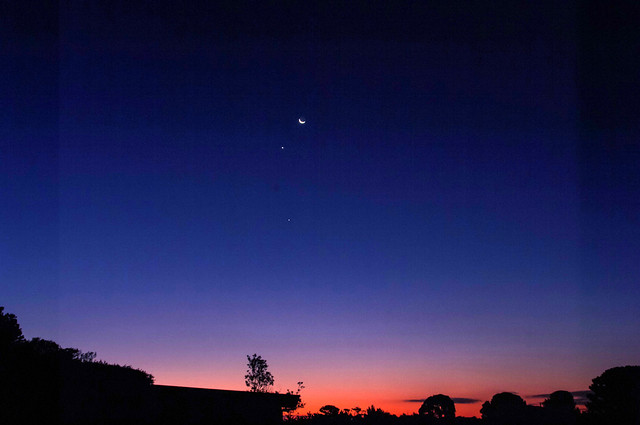
Deep Blue (Indigo in  Newton's Rainbow) happens in a magic way when you take your image after dark. Particularly if you photograph during the Blue Hour (which is the hour or so after sunset (or before sunrise). The eye might see the sky as dark but your camera can capture a rich deep blue with the right exposure.

If you haven't photographed at night, try it tonight. First, a warning, your camera's automatic exposure settings may not work. So you will probably need to experiment with a lower f-stop number, a slower speed and/or a higher ISO.  Rather than give you general numbers, I would encourage you to change that mode dial to M (manual) and start experimenting. To begin make changes that give you more light, then refine in little steps till you capture that beautiful rich blue.

Saturday, July 28, 2018

Lunar Eclipse & Blood Moon

P7280071

The press was full of hype about the longest eclipse and blood moon for a century. So I did want to photograph it and figured Venus Bay would be a great spot to do it. It was until the clouds rolled in. C’est la vie

P7280107

PS Flickr. Instagram and the various local news programs where swapped with similar images, yet there is some pridein that these are my own.

Thursday, July 26, 2018

Full Moon over East Melbourne

IOLYMPUS DIGITAL CAMERA         n a good omen for have a clear view of the full moon tomorrow night/Saturday morning, there was a full moon rising over East Melbourne as I made my way to The Victorian Artist Society Gallery (yellow build on the left).

Tuesday, January 02, 2018

Supermoon tonight but it is already clouding over

imageChecking the Photographers Ephemeris, show I should get a decent view of tonight’s moonrise (the second last supermoon for a fair while, we have has several in the past couple of years) from the car park infront of MGA and the Wheelers Hill Library. The Desktop TPE (The Photographers Ephemeris) is free to access and  can help with sun rise sunset and a number of prediction of natural lighting. It is also available as paid downloadable apps.


The usual problem, clouds seem  to be gathering so fingers crossed.

Friday, June 12, 2015

PhotoEditingTools :: Looking Sharp

image
I’ve stayed away from the use of sharpening. Especially on RAW files because sharpening often lead to extra digital noise. Over sharpening can be very distracting, producing halos around dark or very light edges, How much sharpening is to much? Its a personal decision. All to often the extra detail in a sharpened image is not real just an artifact. It can happen in HDR when too much contrast is included in the tone mapping. So some restraint is desired and access to good sharpening tools esential. Here I am using perfect effects, which splits the sharpening into three groups. the last two are for the screen (not as contrasty) or printer (which then has a series of paper styles) and is much stronger sharpening (to the point of looking a little scary on the screen). However my favourites sharpener are in a group called Fix Focus. My particular favourite being High Pass sharpening, which is also available in Photoshop & Aftershot Pro

Saturday, April 04, 2015

Last Lunar Eclipse Opportunity for a Long While

Lunar Eclipse

We have been fortunate in Melbourne having seen a several lunar eclipses over the past four years, but this will be the last for a while (next for Melbourne will be 2018) . So the eclipse will start at 9:16pm, hit the total eclipse stage (where the moon might be a strong red) around 10:38pm and then finish 12:45am. If you haven’t tried to photographing the moon here is some good advice, its fun.

However the cloud cover is getting thicker fingers crossed it will clear later tonight.

The age has a nice article on-line called  Total lunar eclipse 2015: What you need to know if you want some more details.

Tuesday, January 06, 2015

Changes to sharing via flickr

Speaking of flickr, there have changes going on to the user interface for a while now some are appreciated whilst others are not so welcome. In general I think the changes are fine but one thing I can't find any more is a direct link to share back into here (blogger). There used to be a reasonable process that both format your image and annotated it with a caption and a link back to the original in flickr by just click on a blog this icon, Now the best I can find is via the share icon (a little curved arrow under the right of your image in the single photo). the popup share dialogue is shown on the right. You can still share to a number of "popular site", but google+ and blogger are conspicuously absent. You can however still create some useful HTML code to paste (or Embed) into your post, assuming you know how to do this.
Summer Evening : Full Moon

Why I'm discussing this now is I'm back seeking ways to streamline my web participation & sharing, looking for that elusive POSSE Place [Publish (on your) Own Site, Syndicate Elsewhere] Known is probably the best solution I've found so far, it certainly is the neatest

Wednesday, October 08, 2014

Waiting for the Lunar Eclipse

some hope of clearing skys as the sunsetYet another excuse to photograph the moon, Tonight there was a full lunar eclipse[se expected to be visible over most of Australia. It had been a generally overcast day with just a few glimpse of sun, but I wasn't optimistic about a cloud free sky to catch the eclipse. At sunset I checked the clouds and a there where a few clear patches developing, but it soon clouded over again . Then just after 8pm (we are on daylight saving now) the clouds thinned and cleared completely as the first of the earth shadow started to cover the moon. This lasted about 40 minutes just enough time to get a decent sequence of the shadow progressively covering the moons surface, Just as things where going well over came the clouds. I only got a few glimpses of the flush of red colouring as totality approached and nothing after that.

lunar eclipse

Wednesday, September 10, 2014

Hail, Rain & No Moon Shine

The Super Moonrise was a non-event last night in Melbourne due to a big storm. There was Hail, Rail and Shine Lightening but the heavy clouds obscured the eastern horizon and the moon
 About 3:30 the sky darkened and the rain began In poured with periods of hail for the next hour & half Towards sunset there was a glimpse of a Rainbow
Storm Clouds Roll in as the sunsets
Mainly just darkness, clouds & lightening after that and no moon to be seen. C’est la Vie
No moon just clouds & lightening

Monday, September 08, 2014

Plenty of Cloud ...No Moon

A series of HDR photos in search of the full moonrise (not seen). The weather forcast for tomoorrow is no better.


Saturday, September 06, 2014

Be prepared for more Supermoon hype BUT….

Just a heads up to let you know there will be (yet another) supermoon next week this time over two nights for Melbourne, The term supermoon is not from astronomy it is more astrological. The event is real enough, the full moon corresponds with the closest point that the moon gets to the earth and it can give those interested the opportunity to get some nice photos, because the full moon will rise close to sunset.  Depending on the local atmospheric conditions this could produce a pleasing coloured moon against a richer sky. However there are a lot of myths about the name supermoon, (read this lifehacker post), so don’t expect the moon to be really large or much brighter and there are unlikely to be major catastrophes. If you haven’t witnessed a moonrise its happens surprisingly fast.

…it is a good excuse to photograph the moon

If your moon shoots looks like this don't panic read onHaving dismissed  the hype, photographing the moon can be fun because it is quiet a challenge for an automatic digital camera (as it also is with film based photography). The main problems comes when you rely on light meters, they average the illumination. However the moon is bright against a dark sky, so most often the moon will appear as a bright circle (or big white blob with flare) perhaps with a purple halo and no internal detail. Our eyes however can better handle the contrast and our brain adjusts to a more balanced illumination and we can usually make out at least some detail. The essence of photographing the moon is finding the right exposure to capture the detail of the shadows and craters. There is a lot of advice on photographing the moon on the net, some a little miss-guided but here is a good place to find additional advice.

A photo I took last monthFor the Super moon (or any full moon) close to the horizon, my suggestion for a good starting point will be to use a tripod, set you camera to manual and use a long lens (or zoom in).  Even though this is a night photo try to keep the shutter speed high (1/100 to 1/500) because the moon moves fast. The aperture can be standard (ie around f8) although if you have a foreground subject you want to include and you have the long lens it might be wise to go to a small aperture (eg f22) to avoid depth of field issues taking the moon or the foreground out of focus. This really only leaves you the sensitivity to adjust to get the desire exposure and it will probably be in the range ISO 400 to 1000. Most modern digital cameras will go up to at least ISO 800. EXIF exposure data from the above photoThe ambient light of your position and view can make a couple of stops difference to the exposure so it is a good idea to take a test shot or two of the general scene you want to photograph just beforehand (remembering when the moon rises there will be a little extra light, ie slightly under exposed is ok). Finally if you are familiar with taking bracketed exposure, this is the perfect time to set your camera to take 3 (or 5) photos at a range of EV values (-2 to +2 is a good range if your camera allows this) that way you should get at least one good exposure.

The second common surprise most people get when they photography the moon is it always appears smaller than what they saw? This is particularly so if there is something in the foreground. This is really a function of the cameras focal length being a wider angle (ie 50mm for a DSLR). The solution here is easy use a telephoto lens 200mm or longer, or zoom in and stand further back from the object in the foreground.

The Flickr community team have suggested a series of Noctural and Lunar Global Photo Walks for September, and there has already been a focus of events that match up to the supermoon occurrences next Monday & Tuesday. In Melbourne the key times are shown in the table below

Date Event Time
Monday 8th. September Moonrise 5:11 PM
  Sunset 6:03 PM
Tuesday 9th, September Sunset 6:04 PM
  Moonrise 6:24 PM

Source: WillyWeather.com.au/Melbourne/Wheelers Hill

If you are in Melbourne, we have already had two widely hyped super moons this year, but Tuesday 9th September will be the last opportunity to photograph a super moon from location for the next decade. So cloud cover permitting why not join the flickr global photo walks group and/or a group starting at the Monash Gallery of Art at 6:00 pm, more details on the MGA events page. Even if it is cloudy there should be some good long exposure opportunities.

Monday, August 11, 2014

"Supermoon" but not the moonrise

I missed the moonrise, which gives a lot more photographic opportunity, of the "Supermoon" due to cloud cover, but managed to get a little colour once the clouds cleared.

Wednesday, May 14, 2014

Yellow Moon

The full moon is not so much a harvest moon as just an indication of just how dusty it is out here

Tuesday, April 15, 2014

Lunar Eclipse

There was a full lunar eclipse tonight here in New Zealand just after sunset, but unfortunately it was a heavy cloud cover and raining. So I only got a few glimpses of the eclipse and had to really push the ISO to get any decent exposure. However I was happy that I did capture realistic colour, for the so call "blood moon".