|
Register now through mga Booking Essential.

I can't make promises about the weather, but if its overcast and drizzly the birds will still be flying, so come and bring a raincoat and/or umbrella.
|
I can't make promises about the weather, but if its overcast and drizzly the birds will still be flying, so come and bring a raincoat and/or umbrella.
I haven’t really had the opportunity to test out my higher rate burst mode (continuous shooting) on the Olympus OMD EM10iii. Mainly I had not been in the desirable position of the sun behind me and a cross wind so any birds where taking off while they fly past as I panned. The magic happened late yesterday. Well the camera performed well.
I was shooting in RAW+jpeg and I got the above sequence in a little under two seconds. Not exactly 8fps as claimed but it does give a great range of the full graceful wing movement of a bird in flight. I’ve cropped in a little on the RAW versions, not perfect but I am impressed.
The S mode (Shutter Priority, TX on Canon cameras). Its very simple to use you set the shutter speed and ISO and the camera chooses the best aperture for you.
There is a lot of advice out on the net and in how to books about the importance of keeping shutter speeds fast enough to avoid camera shake. So setting the shutter speed sounds like a good option. It is also helpful if you need to you can “freeze” action by using and ultra fast shutter speed (like 1/2000th of a second), faster infact than a blink of an eye. While I did use this mode on older film cameras, I have seldom used this setting on any of my digital cameras (I’ll explain later below in this post). Like most cameras my new Olympus OMD E M10iii does have an S mode and I was trying to think where I might use it and I settled on birds in flight (be warned that is a challenging subject to try yourself especially starting out, kids on a bike would be a better choice)
That was a bit easier said than done, It was a cold dull overcast morning that Melbourne gets a bad reputation for but aren’t really all that common. So there where not many birds out and about. I figured ducks would still be out, supposed this is the weather they like, so it was down to the lake.
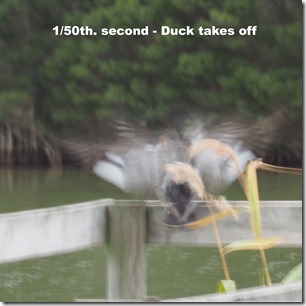
Despite starting to drizzle the duck did perform for me. He was sitting on the wooden rail on a small pier as I approached and a photo with the shutter speed set to a 50th of a second was almost ok (the image has a slight blur but the duck is recognizable despite the low light and slow speed). However as he took off, the next photo, also at 1/50th second is just a blur of feathers. He circled around which gave me time to change the shutter speed and catch him flying in and about to land at 1/2000th. of a second. Now most of the duck is in sharp focus (perhaps expect for him trimming his wing tip feathers). So Shutter Priority mainly helps in deciding weather you want blur or sharpness when you subject is moving. I probably won’t be using this mode to often, but it will help is some situation (if I have enough time to change the mode dial and the shutter speed before my subject has disappeared into the distance. Which it generally has.) Thus you need to plan when using this mode before the action starts.
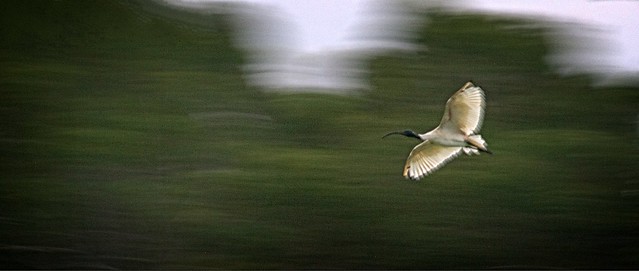
 I have been inspired for a long time to try and find a way with photographs that could do justice in a semi-abstract painterly way to subjects, in a similar way Fred Williams paid homage to landscapes. I had been unsuccessfully trying to photograph a family of very noisy minors in flight. It was late in the day and very overcast and they weren’t cooperating, but I did like the blurred form on one image, The strong shape was both abstract and also characteristic of these birds flight.
  with a coloured almost monochromatic ground, with a few gradations then onto this he paints his abstract often calligraphic shapes that echo the subject. For the ground I figured a painterly almost impasto filter from dreamscope would fit the bill and for the subject I took my photo increased the contrast a little and just overlaid it with a normal blend multi-exposure collage filter in picasa. I like the out-come. I’m still not photographing like Fred would have painted but I am understanding better how to develop the idea.

 I was again running out of options for my patch challenge this week. the hot weather was definitely sapping my creativity not to mention my enthusiasm. Saturday was a scorcher over 40°C and Sunday was shaping up worse, dangerously hot and windy bushfire conditions, but luckily Venus Bay got a change just after lunch. What's good for us humans was not so kind for the terns. They usually fish solo out to sea a bit, up high against a bright sky and diving very fast. They are a real challenge to capture as a decent photo. The cool change bought equally strong if not stronger onshore winds and the terns were grounded for a while taking shelter from the harsh winds on the beach. They arrived alone or in two and threes flying low and on the beach all turned to face the wind.


For some time I have realised that using anti-shake and auto focus while panning after birds in flight was counter productive. Most often I missed the great shot as the lens drives back and forth trying to focus or worse it would find something well in the background, behind the action and I have a blurred bird. So I’ve been brave and stopped down a bit (eg f8 of higher, to get a bit of latitude in depth of field, DOF) and manual focussed in the middle distance where I expected the bird to fly. Then I set the camera into multi-shoot and follow the birds flight in a conventional smooth pan with my finger held down. Depending on the light I usually get a better sequence with just a little motion blur in the background (see below). However the photo above is the last shot in the sequence just as the sea gull is flying out of my depth field range and the distant background, well up the beach, is out of focus. Giving it a pleasingly ambiguous “into the unknown feel”
Its been a while since I series of the Pacific Gulls, down on the beach. previously I used a series of 5 and cropped to the 4:3 format, focussed in the birds themselves. Here I am experimenting with a stronger 2:1 cropping allowing a bit more context as part of a larger picture in time.